Talking Shop May 2026
26th June, 2026

Netflix Reinvents Streaming Ads with AI.
At their May ‘Netflix Upfront’ presentation, the streaming giant announced the roll-out of a new AI-driven advertising format designed to integrate branded content directly into the visual world of its shows and films.
The new format will allow advertisers to match their products with the aesthetics of Netflix originals such as Stranger Things, Bridgerton and Wednesday. The company demonstrated how ads could be dynamically adapted to match the look and feel of a programme, for example, placing a brand within a Stranger Things-inspired environment or reworking creative with the Regency-era styling of Bridgerton.
The AI-generated formats may appear during pause screens or mid-programme ad breaks and could include overlays or calls to action.
Netflix also announced broader developments across its ad business, including new vertical video formats, expanded programmatic buying capabilities, and further investment in audience targeting and measurement tools.
These announcements reflect Netflix’s growing ambition to position itself as a more advanced advertising platform, combining premium entertainment with AI-powered creative personalisation. The company’s ad-supported tier continues to grow rapidly, now reaching 7.2m (24%) of UK homes.
Google Puts AI First.
Google is also focused on using AI to reshape its advertising ecosystem, with major updates across Search, YouTube, Shopping, creative production and campaign management announced at its latest Marketing Live presentation last week.
Key developments for advertisers included:
Further enhancements to Performance Max and AI-powered campaign tools for improved automation in bidding, targeting and optimisation.
New AI-assisted tools designed to help advertisers generate insights, optimise performance and streamline set-up and reporting tasks.
Continued expansion of generative AI creative tools to help advertisers quickly create and adapt creative assets across video, display and short-form formats.
Ongoing development of YouTube as a full-funnel platform, with enhanced shopping features, stronger creator and commerce integrations, and increased focus on driving conversions.
Increased focus on YouTube Shorts as a growth opportunity, with tighter integration across different campaign types.
Updates to measurement and attribution capabilities designed to provide more privacy-safe, cross-platform insight into campaign performance and better support for understanding incremental impact across campaigns.
Continued evolution of Search experiences as Google integrates more AI-driven functionality into how users discover information and interact with results.
Overall, Google’s message was that advertising is moving towards a more automated, insight-led model where AI plays a larger role in campaign execution and optimisation. For advertisers, this reinforces the importance of strong first-party data, clear business objectives and high-quality creative assets, as these increasingly act as the main inputs into automated systems rather than manual campaign controls.
Scotland’s Creator Economy Takes Off.
The recent Scottish Influencer Awards, alongside the upcoming inaugural Scottish Podcast Awards, highlight the rapid growth of Scotland’s creator economy. Whilst traditional media like TV, print and radio are cutting back on local content, independent content creation on TikTok, Instagram, YouTube and podcasting, is becoming a fast-growing and diverse ecosystem.
The Scottish Influencer Awards reflected this breadth, showcasing creators across multiple genres and audience sizes with winners including @foodieholly, a 25 year old amateur cook who won Scottish Food Influencer of the Year (729k followers), and @kennyboyleofficial, Arts and Culture Influencer of the Year (395k followers), known for his entertaining, educational short-form content.
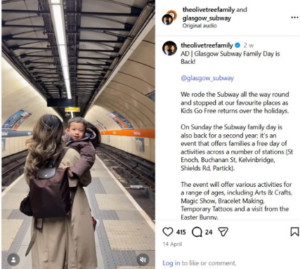
In the Family category, @wildchildwander (Paula Gaughan, 47k followers) was recognised for her honest content around slow childhood, parenting and budget-friendly travel. Also nominated was @theolivetreefamily, with whom we recently worked on a campaign for SPT’s Subway Family Day, demonstrating how influencer partnerships can deliver practical public messaging in an authentic, engaging way.
The inaugural Scottish Podcast Awards will take place at the end of June, and further underline this momentum. Nominated shows such as Off The Ball, Girls Overheard and Scotland Outdoors demonstrate the increasing scale and cultural relevance of the medium in Scotland, with loyal audiences across sport, culture and lifestyle content.
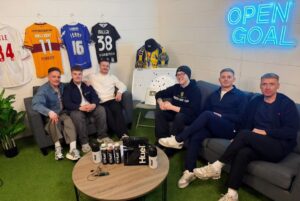
A strong example of podcast-led branded content comes from Open Goal, a Scottish football podcast nominated in 3 categories, fronted by ex-professional footballers, Simon Ferry and Paul Slane, and known for its mix of sport, humour and interviews.
The Media Shop recently partnered with the show on behalf of the University of the West of Scotland to promote its Summer Open Days. As part of the campaign, students studying broadcast production visited the studio to meet the presenters, who will also attend the open day. Engaging content shared on YouTube, Instagram and TikTok is being used to highlight the link between studying at UWS, local creators and real-world media production.
This work reflects how The Media Shop is embracing the growth of the creator landscape, not just in Scotland but across the UK, helping brands connect with audiences through trusted voices and authentic storytelling.
TV Makes Its Case.
TV executives used Thinkbox’s Televisionaries event this week to make the case for why brands matter more than ever, and why TV remains best placed to build them.
The TV marketing body focused on what it sees as the three biggest challenges facing brands today: channel fragmentation, declining trust, and growing anxiety around performance. Against that backdrop, TV was positioned as the medium best equipped to deliver both short and long-term ROI through scale, trust and measurable effectiveness.
Speakers championed the power of “Total TV”, combining the mass reach of linear broadcasting with the addressable capabilities of connected TV (CTV). They also highlighted TV’s advantage in offering professionally produced content that is regulated and independently measured, something many digital platforms still cannot claim. Because of this, TV continues to rank as the most trusted media channel (with influencers ranking lowest).
A closing Q&A brought together senior figures from Sky, ITV, STV, Channel 4 and Amazon to discuss the future of the sector. Industry-wide measurement initiative Project Lantern is now moving into testing, while AI-driven creative and targeting tools were highlighted as key to bringing more UK brands into TV advertising. Ad Pause formats were also identified as a major opportunity, with around 50% of advertisers using them said to be new to TV.
The dominance of social platforms also came under fire, with research cited that suggests advertisers may be overspending on social by as much as three times the required level. Being able to compete with social giant, Meta, and Google, who together account for more than half of UK ad spend, is a key reason that the takeover of ITV (a PSB) by Sky’s US owner Comcast, is likely to be allowed by the CMA when a deal is almost certainly done in the next few months.
Attendees left with a strong reminder of TV’s enduring strengths, but also a clear sense of the fragmented, highly competitive and rapidly evolving market broadcasters are now navigating.
Inside the IAB AI Growth Summit.

The theme of last week’s IAB’s AI Growth Summit was clear: AI is already reshaping media, creativity and consumer behaviour.
One of the standout speakers, Tom Goodwin, compared AI to electricity. Initially, electricity simply made existing tasks easier before eventually transforming industries through innovations like television and telephones. AI appears to be following a similar path, with today’s efficiencies only scratching the surface of its long-term impact.
There were also practical examples for advertisers. ElevenLabs demonstrated their advanced voice cloning technology, creating opportunities for brands to scale audio content, localise creative and speed up production.
A particularly important session from Zehra Chatoo, founder of Code For Good Now, explored bias in AI adoption and outputs. Research shows women are adopting AI at lower rates than men, driven more by ethics and fear of judgement than access or skills. And a recent study identified that identical AI-generated CVs received very different responses depending on whether the applicant had a male or female name.
The summit also highlighted how quickly AI-generated creative is evolving, with the infamous ‘Will Smith eating spaghetti’ clip used as a reminder of how far the technology has progressed in a short space of time.
As AI-generated content becomes harder to distinguish from human-created work, advertisers will need to balance efficiency with authenticity, trust and transparency.
Media Highlight: 30Seconds Media.
Whilst digital media occupies much of our brain space these days, Out of Home continues to quietly grow, scaling up by nearly 3% in 2025. New contextual opportunities are one growth area, as by deploying nuanced, targeted messages that resonate with the current moment, advertisers can forge a more meaningful connection with potential customers.
30SecondsMedia delivers digital screens in lift lobbies and entrance foyers across residential apartment buildings and premium UK commercial offices, creating a final advertising touchpoint before consumers reach their home or workplace. The network enables repeated daily exposure to the same audiences, driving high-frequency impact in affluent environments.
Residential screens span 501 apartment buildings and 35,000 households, with a predominantly age 18-34 audience of students through to AB professionals,. Commercial panels are located in 29 prestigious business addresses, reaching an upmarket AB audience that is 84% aged 18-49 and 59% male.
With six 10-second ad slots per screen, the format is well suited to grocery, entertainment, retail, utilities, and financial services advertisers seeking premium, repeat exposure in relevant, high-attention environments. Contact your Media Shop account manager for more information.
Client Spotlight: Scotch Malt Whisky Society.

We’re delighted to be supporting The Scotch Malt Whisky Society on a membership recruitment campaign built around the idea of helping more whisky lovers ‘Get into the Good Stuff’.
Our campaign combines performance media with highly targeted creator and podcast partnerships, helping the brand reach engaged whisky audiences across multiple touchpoints.
Activity has included collaborations with creators and platforms including Not Another Whisky Podcast, featuring SMWS’s very own European Marketing Manager, Ria McAdam, alongside partnerships with Honest to a Malt, Whisky Sisters and Single Malt Vault.
In addition to influencer activity, we are running a full performance media campaign across paid search, paid social, display, connected TV and digital audio, helping to drive awareness, engagement and membership conversions.
Membership with the Society costs £100 per year and includes a first bottle of whisky, access to exclusive Members’ Rooms, and entry into one of the world’s most unique whisky communities. The Society has also kindly provided The Media Shop with an exclusive ‘friends and family’ offer for new members. Use the code MEDIASHOP when signing up to receive two free glasses with your membership.
Working with such an iconic Scottish brand has been a brilliant opportunity to combine authentic creator partnerships with data-led performance media, helping introduce a new generation of whisky drinkers to everything the Society has to offer and encouraging them to ‘Get into the Good Stuff’.
“We’re delighted with our multi-media recruitment campaign, The Good Stuff.
It focuses on the real value of membership, giving more people the opportunity to access and enjoy the very best of the Scotch Malt Whisky Society.”
Ria McAdam, European Marketing Manager.